
Across centuries and continents, countless Catholics have turned to Mary under one beautiful title: Our Lady of Perpetual Help.
Her image — serene yet strong, tender yet firm — shows her holding the Child Jesus close, guiding Him even as He faces the Cross. In this ancient icon, we glimpse the heart of the Gospel: God’s mercy made visible in the arms of His Mother.
Whether you’re walking through exams, mission work, or daily uncertainty, Our Lady of Perpetual Help reminds us that Christ’s help is never far — it’s perpetual.
What does “Our Lady of Perpetual Help” mean?
The phrase “Our Lady of Perpetual Help” (also called Our Lady of Perpetual Succour) is a title given to the Blessed Virgin Mary, connected with a 13th- to 15th-century Byzantine icon. The icon depicts Mary holding the Child Jesus, while above them the Archangels Michael and Gabriel present the instruments of His Passion.
The title emphasizes Mary’s maternal role and her constant intercession — “perpetual help” meaning she is ever-present, ever-listening, ever-loving.
Why is this devotion important for FOCUS?
- Comfort in Missionary Discipleship: One of your goals at FOCUS is helping students become missionary disciples — and Mary under this title shows us how to accompany others, lead them to Christ, and trust in God’s help.
- Hope in the Tensions of Student-Life: College life often brings transition, uncertainty, academic stress, and big decisions (vocational, relational, faith-wise). Mary as “Our Lady of Perpetual Help” offers a tangible reminder: you are not alone. She brings you to Jesus.
- Invitation to the “Perpetual”: When we think of “perpetual,” we might think of something continuous, unceasing. For young adults busy with activities, studies, jobs, relationships, Mary’s analogy invites us into a rhythm of turning-to-her and turning-to-Christ — even amidst the busyness.
- Bridge for All Ages: As you write for a broad audience — college students, young professionals, older adults — this devotion works across ages. The image and story are accessible, the message timeless.
A Brief History of the Icon
- The icon likely originates in Crete, sometime between 1325–1480 A.D., based on art-analysis and carbon-dating.
- It was brought to Rome by a merchant and placed in the church of San Matteo in Via Merulana (between St Mary Major and St John Lateran) in 1499.
- In the 19th century, under Pope Pius IX, the icon was entrusted to the congregation of the Redemptorists, and its devotion was widely promoted.
- Today the original resides in the church of Sant’Alfonso di Liguori on the Esquiline Hill in Rome (via Via Merulana).
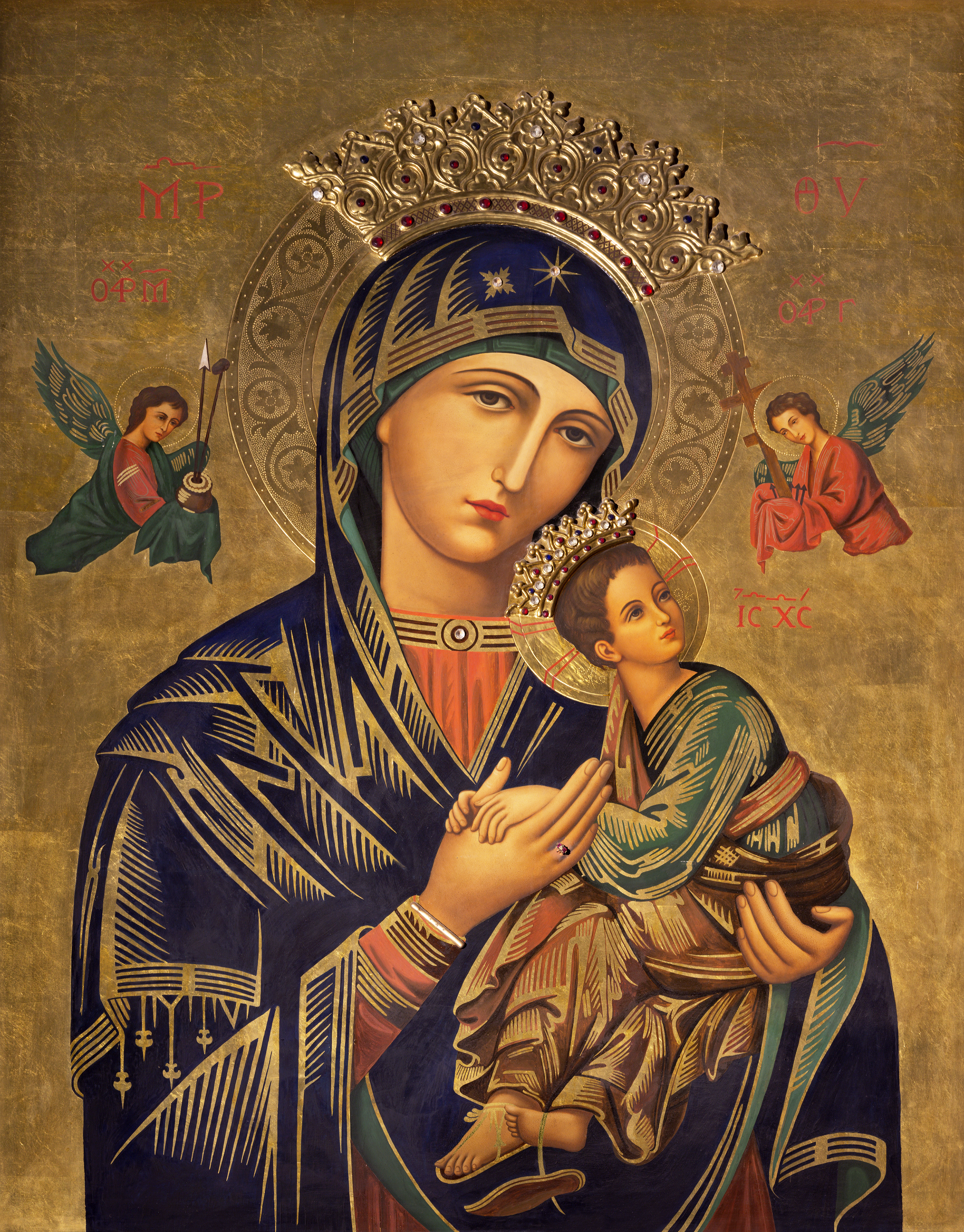
Understanding the Symbolism
This icon is rich with theological meaning. Here are a few key details and why they matter:
- Mary’s eyes look out at us; she points to her Son — an image of “Hodegetria” (“She who shows the Way”).
- The Child Jesus, while held by Mary, looks out in fear at the instruments of his Passion (the cross, nails, lance, sponge) held by the angels: a depiction of His human fear and divine mission.
- One of Jesus’ sandals is slipping or has fallen off — interpreted by many as the haste with which He turns to Mary (and us) in heed of his Passion.
- The gold background signifies the glory of the Resurrection — even amid the depiction of suffering, we glimpse hope.
- The star on Mary’s veil (or shoulder) evokes “Star of the Sea” — she guides us safely to Christ.
What Does This Devotion Mean for Us Today?
For our modern lives — with Zoom classes, internships, relational ups-and-downs, mission trips, big decisions about vocation and service — this Marian devotion speaks powerfully:
- Trust Amid Disorientation: Just as the icon shows Jesus in an anxious posture, we too have anxious moments. Mary invites us to bring our fears, our “What’s next?”, our loneliness to her.
- Mission-Centered Heart: The Redemptorist commentary says the icon “is the representation of the permanent visit that God makes to his people … He comes to meet us in his Son presented by the Mother.” As missionaries (even student-missionaries) we can live from that truth: Jesus meets us, Mary leads us, others are served.
- Communal Devotion: Many parishes hold weekly novenas to Our Lady of Perpetual Help (e.g., on Wednesdays) where people bring intentions, healing prayers, hopes for family and friends. Aligning campus ministry with that rhythm can be a beautiful anchor.
- Image as Conversation-Starter: The visual is striking and invites questions. In a retreat setting, bring a print or screen-shot of the icon and ask: “What draws your eye? What might Jesus be feeling? What might Mary be inviting you to hand over to her?”
Practical Ways to Bring This Title into Your Life and Ministry
- Display the Icon: At a house, dorm-room, ministry office, or retreat room. Encourage students to say: “Mary, our help is in you.”
- Offer a Novena: Use booklets devoted to Our Lady of Perpetual Help in a weekly group meeting or small-group setting (Wednesday works well).
- Teach the Symbolism: At a retreat or small group, unpack the symbolism of the icon and invite reflection: “I see … I wonder … I feel …”
- Associate It With Service: The title suggests “help” — invite students into service opportunities (food pantry, tutoring, campus outreach) in the spirit of Mary’s maternal care.
- Prayer for the Mission: Use Mary’s intercession in your prayer life: “Our Lady of Perpetual Help, pray for us who have recourse to thee.” (A traditional prayer)
- Use in Blog/Email Content: Because you’re writing for FOCUS’s blog, you could include downloadable wallpapers of the image, reflection questions, or links to novena resources.
FAQ
Q: Who is Our Lady of Perpetual Help?
A: She is the Blessed Virgin Mary under the title given to a famous Byzantine icon depicting her holding the Child Jesus, while the archangels Michael and Gabriel show the instruments of His Passion.
Q: What is the story behind the icon of Our Lady of Perpetual Help?
A: Art-analysis suggests the icon was created between 1325–1480 and painted on wood, probably in Crete. It arrived in Rome around the end of the 15th century.
Q: When is the feast day of Our Lady of Perpetual Help?
A: The Feast of Our Lady of Perpetual Help is celebrated on 27 June in the Latin Church.
Q: What does the icon of Our Lady of Perpetual Help mean?
A: The icon’s meaning is rich: Mary pointing to Christ, Jesus showing fear and trust, the angels holding Passion instruments, the gold background showing glory, the slipping sandal indicating Christ’s humanity. It invites us into trust and hope.
Q: How do I pray to Our Lady of Perpetual Help?
A: A common way is through the novena which many parishes hold weekly (often Wednesdays). You can pray: “Our Lady of Perpetual Help, pray for us who have recourse to thee.” You might also reflect on the icon and ask Mary to bring your need to her Son.
Q: Why is Our Lady of Perpetual Help popular in Catholic devotion?
A: Because she represents Mary’s motherhood, Christ’s nearness, and the constant help of God in our temporal struggles. The icon has been associated with healings and answers to prayer over many centuries.
Q: Where can I see the original icon of Our Lady of Perpetual Help?
A: The original is enshrined at the Church of Sant’Alfonso di Liguori in Rome, entrusted to the Redemptorist Fathers.
Q: How can a student or young adult live out devotion to Our Lady of Perpetual Help?
A: Some practical ways: display a picture of the icon in your study-space; join or start a weekly novena group; in your service outreach think of Mary’s care for Jesus and others; when stressed invite Mary’s intercession before exams or decisions.
Q: Can the devotion to Our Lady of Perpetual Help help with anxiety or stress?
A: Yes. The very image shows Christ’s fear and Mary’s caring hold. That speaks to our own vulnerability and to Mary’s constant mother-care. It can be a reminder that we bring our burdens to Jesus through Mary.
Additional Resources
Want to learn more about Mary and the saints? Explore these posts on the FOCUS blog:
- Who Are the Most Famous Catholic Saints?
- Your Favorite Saints’ Favorite Saints
- 25 Patron Saints of Really Random Things
- Why Do Catholics Pray to Mary?
- 5 Ways to Pray to Mary
Looking for more? Visit the Meet the Saints series to read about holy men and women who lived Mary’s “yes” in every age.
Check out the FOCUS YouTube channel for reflections and videos on Mary and the saints—like the one below:
 Give
Give
